Plot your trail
Sketch a path to the life you want.
What path could move you from where you are to where you want to be? Designing your life means sketching a realistic route forward. Not a perfect plan, just a clear direction and a few next steps.
✳️✳️✳️
In the earlier life design phases, you looked honestly at where you stand in key areas of your life and defined what you want to improve by framing a design question, such as “How can I get enough exercise every week?”
In this phase, you sketch a life path that could take you from where you are now to where you want to go. This usually doesn’t require major changes like switching jobs, ending a long-term relationship, or moving abroad. Often, a few small changes in the right direction are enough to gradually improve what you already have until it’s good enough for you.
You’re not making final decisions or committing to anything yet. You’re simply exploring options and possible paths. If you’re facing a major life change or feel completely stuck, it can help to sketch three very different life paths for the next five years.
Plotting your trail is like drawing a map of the path you want to take.
To plot a life path, generate many ideas that could move you toward your design goal. Group similar ideas, then choose the three most promising directions to explore.
1️⃣ Generate many ideas
In the previous phase, you formulated your design question: How can I <what you want to achieve>?
Use this question to generate as many ideas as possible to move from where you are now to where you want to go. Focus on quantity, not quality. Your first idea is rarely your best. It’s often the most obvious or familiar, shaped by existing assumptions and the urge for quick solutions. More ideas mean more perspectives and a higher chance of finding a life path that works for you. Take your time, this process can take days or even weeks.
Write down every idea without judgment, especially wild or unconventional ones. Capture each idea separately, on a sticky note, card, or digitally, so you can group them in the next step. How you generate ideas matters less than producing enough to support your design goal.
Ways to get ideas
👉 Gather ideas from reliable sources: blogs, social media, books, journals, documentaries, lectures, or podcasts relevant to your design question. Ask trusted others for suggestions and involve your life design team if you have one.
👉 Look at yourself and your environment. What changes could help you reach your goal? Consider shifting unhelpful beliefs, habits, fears, or aspects of your social and physical environment. Small changes can have big effects.
👉 Challenge assumptions. Ask yourself which “obvious” solutions you might be taking for granted. Questioning them often uncovers new possibilities.
👉 Decide what activities to start or do more of and which to stop or do less of to move closer to your goal.
👉 Use idea-generating techniques such as brainstorming or brainwriting to come up with lots of ideas, including wild and unconventional ones.
Example
Here’s a simple example of ideas sparked by the design question: How can I get enough exercise every week?

2️⃣ Group similar ideas
You now have a large collection of ideas on sticky notes, cards, or stored electronically. Some of these will be similar, like ideas for using your car less or exercising more. Group related ideas into themes and give each theme a brief description, such as “Use my car less” or “Exercise more.” Place ideas that don’t fit any theme under “Other.” Add any new ideas you come up with to the appropriate theme. This gives you a set of themes, each with its associated ideas.
For the simple example, the diagram below shows one possible grouping.

Save your themes and their associated ideas for future use. You can do this electronically or by taking a photo of your notes or cards.
3️⃣ Reduce to about seven ideas
Life design is about taking action. Your ideas only deliver value if you focus on a few and act on them.
The human mind can only handle a limited number of options. Having too many options can leave you unable to make any choice at all. The first step, then, is to narrow your ideas to about seven. You may feel resistance leaving good ideas behind, but it’s necessary. Remember, you always have your saved copy to fall back on if you get stuck later.
You can choose individual ideas from your themes, or include an entire theme as a single idea. In that case, use the theme’s name as the idea, for example: “Use my car less.” Select about seven ideas by focusing on those that appeal to you most or by eliminating ideas you like least until only about seven remain. Use both your mind and your feelings: choose ideas that make sense and feel right for you.
Apply simple criteria to guide your selection: effectiveness (how much it helps reach your goal), feasibility (how easy it is to act on), and positive impact (benefits for you or others).
Try a quick trial visualization: imagine putting each idea into action for a week or a month and notice how it feels. This helps you see which ideas are realistic, motivating, and aligned with your life.
Keep the 80/20 principle in mind: a few ideas often produce most of the results. Focus on the ideas that give the biggest impact with the least friction.
In the simple example, the selected ideas are highlighted with a red box in the diagram below.

4️⃣ Choose the three most promising ideas
Select the three ideas (or fewer) that seem most likely to help you achieve your design goal. These are the ideas you will act on.
👉 You can choose them as in the previous step: focus on the ideas that appeal to you most or remove the ones you like least. Use criteria such as effectiveness, feasibility, or potential positive side effects. With only a few ideas left, you can also use more structured methods.
👉 Team scoring: If you’re working with a life design team, each member can divide ten points among the ideas. The three ideas with the highest total points become the most promising.
👉 Pairwise comparison: Compare ideas two at a time, giving a point to the idea you consider more promising. The three ideas with the highest scores become your most promising. The diagram below shows an example.

👉 Decision matrix: Compare ideas on two aspects, for example feasibility (low to high) and contribution to your design goal (low to high). The table below shows an example for the simple case.
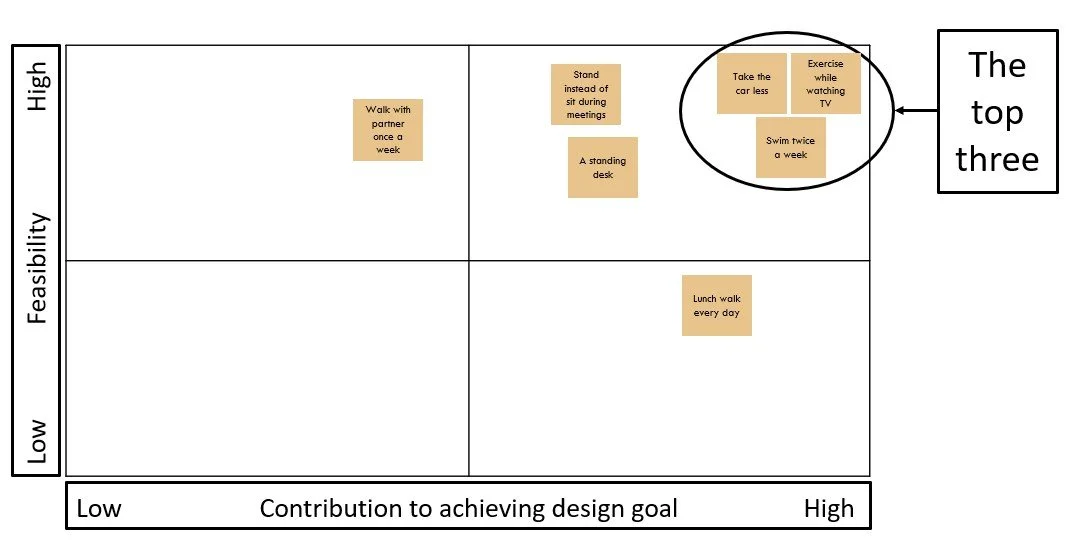
🖊️ After selecting your three most promising ideas, write your life path in this format:
“I’m going to <idea 1>, and <idea 2>, and <idea 3>.”
This is the life path you will follow to achieve your design goal.
Example: I’m going to exercise while watching TV, swim twice a week, and take the car less.
5️⃣ Keep your results
Save everything you produced in this phase. If your ideas are on sticky notes or cards, take photos or store them electronically. You may need these ideas later, for example if you get stuck during the process.
🎉👏🎈
Based on your design question, “How can I <what you want to achieve>?”, you’ve determined a life path by selecting three ideas you believe can help you achieve your goal. In the next phase of the life design process, you will test these ideas to see if they actually work for you.
References
Designing Your Life, by Bill Burnett and Dave Evans