Survey where you stand
Take a realistic snapshot of your life.
What’s working in your life, and what isn’t? Designing your life, setting priorities, and adjusting course all begin with seeing your life clearly.
✳️✳️✳️
Just as a ship sets sail from the port where it is, designing a fulfilling life starts from where you are now. You can’t begin from where you wish you were, but you can create a well-designed life from your current starting point, even if it is not where you want to be.
To decide where to go next, you first need to know where you are. That’s why you will assess a few major areas of life: physical health, emotional health, work, and relationships. These areas cover much of what shapes everyday experience. If another area is especially important to you right now, feel free to include it. You might add an area like finances, personal growth, autonomy, community, leisure, or purpose. For a fuller description of these areas, see Key areas of life.
Surveying where you stand is like pausing on a trail to see the ground you’re on.
⚒️ Survey where you stand now
Begin by taking an honest look at how things are going in your life. There’s no need to judge or fix anything yet. The goal is simply to see your current situation clearly.
1️⃣ Create a table for each life area
Set up one table for each life area you want to review.
Grab a pen and paper, or open an electronic document. For each life area, create a table similar to the one shown below. Do this for physical health, emotional health, work, relationships, as well as any additional life area you chose to include. Leave enough space in each table to add multiple entries as you reflect.
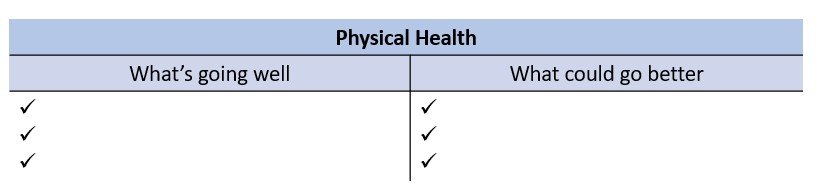
2️⃣ Identify what is going well and what could be improved
Take stock of what is working and what is not, without trying to fix anything yet.
For each life area, note a few key points about what is going well and what could be improved. The aim of this step is simply to take stock of how things are going. There is no need to change anything yet. Just focus on noticing and naming what you see.
Some hints and tips before you start
👉 Consider a broader timeframe rather than a single moment. Look at patterns over weeks or months, not just how things feel today.
👉 We naturally pay more attention to what isn’t working than to what is. To get a balanced view of each life area, notice not only what could be improved, but also the most important things that are going well.
👉 Focus on things you can influence or control. Treat factors outside your control as circumstances or facts, and allow them to be what they are.
👉 Approach this exercise with curiosity. Try to observe your life from a bit of distance, as if you were an impartial scientist studying your current situation. Be honest with yourself and look at reality as it is.
👉 Avoid judging yourself for what could be improved. Your life is imperfect, and that is part of being human. Perfect lives do not exist. There is also no need to praise yourself for what goes well. Aim for a clear, honest view rather than evaluation.
👉 Where possible, note why something is going well or not going well yet. Ask yourself what you think is contributing to the situation.
For each table, note your perception of how things are going. On the left side, list the main things or activities that are going well, that energize you, bring satisfaction, or align with your values and purpose. On the right side, list the main things or activities that could be improved, that drain your energy, do not bring satisfaction, or do not align with your values or purpose. Focus on observation, not judgment. This is about understanding your life as it is right now, not fixing anything yet.
👉 Complete the physical health table
Consider aspects such as sleep and rest, exercise, nutrition and hydration, blood pressure, body weight, waist-to-hip ratio, cholesterol, heart rate, tobacco or vaping use, alcohol and drug use, fatigue, muscle strength and endurance, aerobic fitness, flexibility, mobility, and regular medical checkups.
👉 Complete the emotional health table
Focus on your emotional health overall, not just how you feel today. In the “What could go better” column, include only things that significantly hinder daily functioning, such as obstacles to doing what matters or issues that consume a lot of mental energy.
Consider aspects such as managing and accepting your thoughts and feelings, handling stress and challenges, expressing feelings appropriately, self-talk, self-care, seeking support, having a sense of purpose, taking responsibility, focusing attention, and maintaining a growth mindset.
👉 Complete the work table
This area includes both paid and unpaid work, as well as your professional development. It is less about what you do and more about why you do it. Ask yourself questions such as: Why am I working? What motivates me? What makes work worthwhile for me?
Consider aspects such as alignment with your purpose and values, activities that energize or drain you, fulfillment, job satisfaction, security, compensation, work-life balance, flexibility, sense of belonging, involvement, health and safety, autonomy, recognition, workload, service to others, and opportunities for professional growth.
👉 Complete the relationships table
Consider the quality of your relationships with people who matter to you, including close friends, family, and a life partner if you have one. Reflect on how you communicate and relate to others, such as listening, expressing thoughts and feelings openly, resolving conflict, and setting and respecting boundaries. Also consider mutual respect, empathy, emotional support, shared purpose and values, honesty, appreciation and gratitude. This area can also include your sense of connection to nature, art, music, or pets.
👉 Complete the table for your additional area (if applicable)
If you added an extra life area, such as finances, personal growth, autonomy, community, leisure, or purpose, complete a table for that area as well. Use the same approach as before, focusing on what is going well and what could be improved.
3️⃣ Review and refine your entries
Revisit your tables over a few days and adjust them as your insights deepen.
Review what you entered in each table using the hints and tips from the previous step. Adjust or clarify entries where needed. Over the course of a few days, revisit the tables at the end of each day and add, remove, or refine items based on what you noticed or experienced that day.
Take your time with this step. Getting an accurate picture of where you are in each life area matters. It gives you a solid basis for deciding which area needs the most attention next.
4️⃣ Rate the life areas
Create a table similar to the one shown below, using paper or an electronic document. Include each life area you reviewed and, if applicable, add your additional life area as well.

Some hints & tips before you rate each life area from 1 to 10
👉 Before rating a life area, read through your notes on what is going well and what could be improved. Use these observations to inform your score.
👉 Don’t overthink the rating. This is your subjective assessment of how things are going right now. Only you know what feels good enough or not good enough for you at this moment.
👉 Consider how this life area has been going over the past weeks, not just today, to give your rating context.
👉 Be honest with yourself and acknowledge reality as it is now.
👉 Avoid judging yourself for low scores. All scores are valid. Don’t waste energy resisting your current situation. Use that energy to design and build the life you want. You can create a well-designed life from any starting point.
👉 Think of the scores as gauges on a car’s dashboard. They give you information about the state of each life area. Sometimes a low score is simply a signal that attention or change may be needed, much like a warning light drawing your focus.
For each life area, rate how you are doing right now on a scale from 1 (terrible) to 10 (perfect). Then write a one-sentence explanation of why you gave that score. Consider which needs, desires, or values are being met and which are not. Use this as a way to understand your life more clearly, not to judge yourself.
5️⃣ Keep your results
Save everything you wrote down. This information will be needed for the next steps in the life design process and can also serve as a reference for the future.
🎉👏🎈
You’ve now taken stock of how things are going in your key life areas. The next step is to decide where you want to go and which area to focus on first, so you can start shaping a life that aligns with your purpose and values.
References
Designing Your Life, by Bill Burnett and Dave Evans